For those looking to advance their careers or take that next step, enrolling in a Java Full Course in the USA provides a proven pathway to reliable, high paying employment now and in the future across industries.
In today’s digital-first economy, Java continues to be one of the most reliable programming languages at the core of worldwide enterprise technology. From financial services to e-commerce and healthcare, Java is everywhere. Java is a programming language that millions of developers and organizations trust for its stability, scalability, and security.
In this guide, we will examine what a Java Full Course in the USA usually looks like — its syllabus, the time and costs involved in completing it, and some of the diverse career paths for those who are proficient in it. You will also learn how Unique System Skills (USS), a US-based IT training and consulting organization, helps learners develop current, in-demand, job ready skills that bridge educational programs with immediate employability.
Why Learn Java in the USA ?
Java isn’t merely another programming language; it is the basis of enterprise-level systems for companies, such as Oracle, IBM, and JP Morgan Chase. Its “Write Once, Run Anywhere” philosophy allows Java applications to run across different platforms without modification, establishing it as the main programming language for extensive, distributed systems.
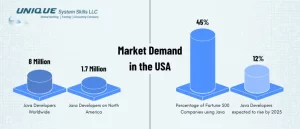
In the United States, Java developer job market remains strong. According to CompTIA’s 2025 Tech Jobs Report, java continually ranks in the top 10 most in-demand coding languages. The North American Java training market is forecast to grow nearly 15% annually through 2033 as companies search for developers able to work in hybrid cloud and microservice-based systems.
For students and professionals thinking about changing careers, this stability equals predictability – a much-desired asset in the quickly evolving tech world. Whether your interest is in designing enterprise web applications, mobile solutions, or data systems, completing a Java Full Course in the United States gives you the knowledge to grow confidently in the international IT job market.
Core Curriculum of a Java Full Course in the USA
Every successful career starts with a strong foundation. Essentially, a Java Full Course in the USA in most cases has learners mastering Core Java first, as building blocks that prepare learners for deeper enterprise or full stack development.
Generally speaking, the course will start with configuring the Java environment – installing the Java Development Kit (JDK) and working with an IDE (integrated development environment) such as either IntelliJ IDEA or Eclipse. You generally learn about:
- Language Fundamentals: Developing syntax, variables, operators, loops, and conditional statements that dictate the logic of a program.
- Object-Oriented Programming (OOP): This is the essence of Java as the new concepts of classes, objects, inheritance, encapsulation, and polymorphism organize the way for learners to think about and develop reusable code.
- Collections and Data Structures: Using Arrays, Lists, Maps, and Sets to manage and process data.
- Exception Handling and Multithreading: Handling errors appropriately and allowing a program to handle multiple threads at once.
- JDBC (Java Database Connectivity): Connect your application to a database such as MySQL or PostgreSQL.
- Testing and Version Control: Learning to use basic tools, such as JUnit for testing and Git for version control and collaboration.
It is at this point that learners can start to think critically about software design and progress with confidence into full stack and enterprise Java software development. The training at Unique System Skills (USS) follows this structured approach, ensuring that students understand both the “how” and the “why” behind every concept.
Advancing with a Java Full Course for in the USA
When students are ready to move beyond the basics, they join the advanced level — the full stack java developer course in the US, which is a complete end-to-end application development course that usually covers the entire software development life cycle, and process, which is surely more than just backend programming.
Part of the full stack java developer training in the United States is developing scalable applications that cover user interfaces, database, and server-side logic. Usually, full stack java developer training will cover:
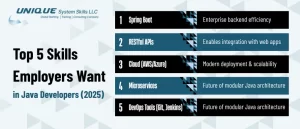
Backend Development and Enterprise Frameworks
Spring Framework and Hibernate ORM frameworks are the most widely used frameworks in modern Java enterprise applications.
- Spring Boot accelerates application setup and deployment with built-in tools.
- Spring MVC provides a structured pattern for managing requests and responses.
- Hibernate streamlines working with databases by abstracting the need to write the repetitive SQL.
Frontend Integration
To be true full stack developers, students must know HTML, CSS, and JavaScript. Students are also introduced to modern frameworks like React or Angular so that they are able to create modern, dynamic, responsive web sites with APIs pointing to back-end applications.
Web Services and Microservices Architecture
Many modern applications use RESTful APIs and Microservices, allowing teams to create independent components that exchange messages with high efficiency. This microservices architecture is fundamental to scalability and enterprise reliability.
Exposure to DevOps and the Cloud
With enterprises moving to the cloud, developers and software engineers with exposure to Docker, Kubernetes, and AWS/cloud deployment pipelines have an advantage. Full stack development programs do not just educate graduates with the skills to build software, but teach them how to deploy and manage software efficiently.
At Unique System Skills (USS), we weave all of these elements are woven together through practical, mentor-led projects that create environments similar to where learners will be working when they graduate. Students learn by actually building then deploying a full stack application, which develop technical and professional confidence.
Career Roles and Salaries
After learners complete a Java Full Course in the USA, depending on their area of concentration and career ambitions, there are many potential employment opportunities. The java stack in the USA is designed as a continual learning experience that rewards building expertise.
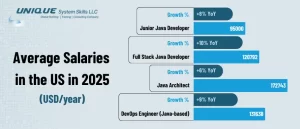
| Role | Key Focus | Typical Annual Salary (US) |
| Junior Java Developer | Write and test application code under supervision | $115,000+ |
| Full Stack Java Developer | Manage client-side and server-side systems | $120,000+ |
| Android Developer | Build mobile applications using Java and Kotlin | $110,000+ |
| DevOps Engineer | Automate and deploy Java applications | $130,000+ |
| Java Architect | Design system architecture and technology stack | $170,000+ |
Salaries vary by area, professional experience level, and complexity of project development. For example, in certain cities, including New York and San Francisco which are well known for technology, compensation on average is typically from 20% to 25%.
Employers in the USA place a high value on any Java professional that exhibits not just coding ability, but also that they are a system-level thinker, or are able to design, deploy and optimize solutions that are enterprise-level.
Job Readiness through Unique System Skills LLC USA
Completing a java full course developer training in the USA is only the beginning. The real differentiator lies in career readiness and the ability to present yourself as a skilled, confident professional ready for the US job market.
Unique System Skills (USS) places special emphasis on bridging the gap between learning and employability through:
- Globally Recognized Certifications: Candidates learn how to gain credentials such as the Oracle Certified Professional Java SE (OCP) or Spring Professional Certification that are credible, employable, and recognized globally.
- Real-World Projects: Every learner builds a portfolio of projects that evidences their ability to solve real problems for real businesses using Java, Spring Boot, Hibernate, and cloud-to-edge architecture.
- Mock Interviews and Resume Support: One-on-one mentoring, specifically interview coaching and assistance with optimizing LinkedIn profiles to differentiate students in a crowded, often competitive hiring environment.
- Placement Assistance: Specialized teams focused on working with graduates to connect them with major employers across many industries and connect them with new opportunities for Java developer, cloud engineer, or software architect roles.
This holistic approach ensures that graduates of Unique System Skills’ Java Full Course in the USA are employable, not just skilled in the rank-and-file hard skills.
The Value of a Java Full Course in the USA
There is a broad range of costs for Java Full Course in the USA based on length, delivery mode (online vs face to face), and depth of curriculum. Typically, the cost of a program can range from a full-time intensive 12 weeks of boot camp, to a single 6-month professional certification.
What is most important is return on investment (ROI) — and it’s the sustained and continual demand in the industry for Java that marks it as one of the safest, and most rewarding continuances to learning today. As a field of programming, Java developers continue to see consistent increases for income, job flexibility, and ability to specialize in work of demand like DevOps Engineer, Full Stack Developer, and Java Architect.
At Unique System Skills (USS) we provide mentorship as part training, project led training that helps realize the maximum value in learning. Working with a focus on application in hand-on practice, at USS we ensure that a learner goes from theory, to practical application, faster thus ensuring we maximize the learners time, and investment.
Why USS LLC Stands Out for Java Full Course?
Selecting a suitable training provider is just as critical as selecting an appropriate career path. Unique System Skills (USS), based in the USA, has created a reputation for empowering students and workers through outcome-based IT training.
What differentiates USS is its emphasis on instructor-led mentorship and training based on the needs of employers. Where most generalized online courses are devoid of this human aspect, USS programs utilize live instruction, case studies from the field, and ongoing feedback from industry analysts.
Graduates from USS’s Java Full Course in the USA leave as not only coders, but confident problem-solvers ready to take on enterprise-level projects. Further, the institution’s employment support is based in the USA which allows students to be in the same room as their future employer, who is looking to hire someone with Java expertise.
For students beginning their career, and workers aiming for a transition to tech, USS brings both the technical and strategic support they need to thrive in a competitive global language
The Future Is Written in Java
From a relatively obscure programming language in the mid-1990s, to a mainstream enterprise powerhouse, Java’s transformation shows how programmers can count on the language. For someone who wants to truly create a successful and satisfying career in technology, learning Java is still one of the smartest moves they can make.
o, whether you’re a student looking to enter the tech world or a professional interested in changing careers, now is the time. With the right training, mentorship, and vision, you’re already on the path to achieving your goal of becoming a skilled java full course developer in 2025, and Unique System Skills is with you every step of the way.